AERONIX TECHNICAL BLOG SERIES
1. How to Select a Pneumatic Conveying System
Selecting the correct pneumatic conveying system requires evaluation of material characteristics, conveying distance, capacity, plant layout, product sensitivity, and operating costs. The choice between lean phase, dense phase, vacuum, pressure, or closed-loop conveying should be based on engineering analysis rather than equipment preference.
2. Lean Phase vs Dense Phase Conveying
Lean phase conveying uses higher air velocities and lower pressure, while dense phase conveying uses lower velocities and higher pressure. Dense phase is preferred for abrasive or fragile products, whereas lean phase is often selected for lower capital investment and simpler operation.
3. Common Pneumatic Conveying Problems
Common issues include pipeline blockage, product degradation, excessive wear, poor separation efficiency, high energy consumption, and unstable feeding. Most problems originate from improper system design or incorrect material characterization.
4. Pneumatic Conveying Design Parameters
Key design factors include bulk density, particle size, moisture content, conveying distance, conveying rate, pressure drop, saltation velocity, pipeline diameter, and air-to-material ratio.
5. Pressure Drop Calculation Basics
Pressure drop is one of the most important calculations in pneumatic conveying design. It determines blower selection, pipeline sizing, energy consumption, and overall system performance.
6. How to Size a Dust Collector
Dust collector sizing depends on airflow requirements, dust loading, process conditions, filtration velocity, and emission limits. Proper sizing ensures efficient dust capture and long filter life.
7. Bag Filter vs Cartridge Filter
Bag filters are suitable for higher dust loads and larger airflow requirements, while cartridge filters provide higher filtration efficiency in compact spaces. Selection depends on application requirements and dust characteristics.
8. Industrial Dust Control Best Practices
Effective dust control includes source capture, proper duct design, correctly sized dust collectors, regular maintenance, and compliance with workplace safety regulations.
9. Dust Explosion Prevention
Many fine powders can create explosive dust clouds. Prevention methods include proper housekeeping, dust collection, grounding, explosion venting, isolation systems, and safe operating practices.
10. Understanding Dust Loading
Dust loading refers to the concentration of particulate matter entering a dust collection system. Understanding dust loading is critical for filter sizing, collector selection, and maintenance planning.
11. Why Starch Creates Flow Problems
Starch powders often exhibit bridging, rat-holing, and compaction due to fine particle size and moisture sensitivity. Proper hopper design and flow promotion equipment are essential.
12. Carbon Black Handling Challenges
Carbon black presents unique challenges due to low bulk density, extreme dusting tendency, contamination concerns, and difficult flow characteristics. Dense phase conveying is often the preferred solution.
13. Handling Calcium Carbonate Efficiently
Calcium carbonate is widely used in plastics, paints, and minerals industries. Efficient handling requires proper conveying velocity, dust control, and wear-resistant equipment selection.
14. Milk Powder Conveying Best Practices
Engineered for Reliability
Milk powder systems must prioritize hygiene, product integrity, dust control, and ease of cleaning. Vacuum conveying and food-grade equipment are commonly used.
15. PVC Resin Conveying System Design
PVC resin handling systems require reliable conveying, storage, and feeding solutions while minimizing segregation, contamination, and product degradation.
16. Understanding Bridging and Rat-Holing
Bridging occurs when material forms an arch above the outlet. Rat-holing occurs when only a narrow flow channel develops. Both reduce storage efficiency and disrupt production.
17. Silo Design Considerations
Proper silo design involves storage capacity, hopper geometry, discharge requirements, structural loading, flow characteristics, and integration with conveying systems.
18. Selecting Flow Promotion Equipment
Flow promotion equipment such as bin activators, vibro dischargers, and bin aerators helps eliminate flow problems and improve discharge consistency.
19. Bin Activator vs Bin Aerator
Bin activators use vibration and mechanical agitation, while bin aerators use low-pressure air to improve powder flow. Selection depends on material properties and storage conditions.
20. Hopper Design Fundamentals
Hopper outlet size, wall angle, material flow properties, and discharge requirements determine whether a hopper will provide reliable material flow.
21. How to Select a Rotary Airlock Valve
Rotary valve selection depends on conveying pressure, capacity, material characteristics, rotor design, air leakage requirements, and operating conditions.
22. Screw Conveyor Design Guide
Successful screw conveyor design requires consideration of material density, flowability, capacity, conveyor length, inclination angle, and wear characteristics.
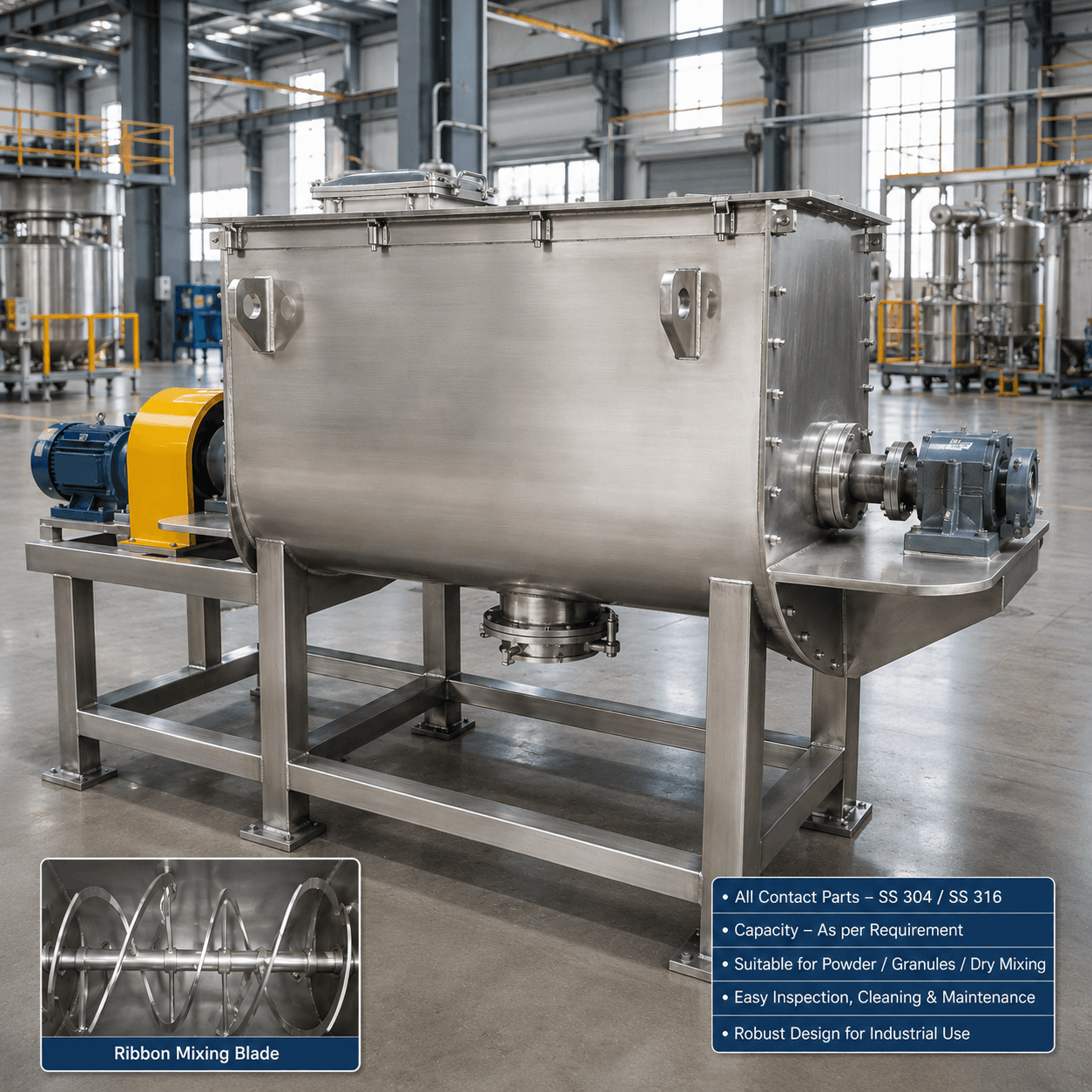
23. Selecting a Ribbon Blender
Ribbon blenders are ideal for dry powders requiring homogeneous mixing. Selection depends on batch size, material characteristics, mixing time, and cleaning requirements.
24. Paddle Blender vs Ribbon Blender
Paddle blenders provide gentle mixing with lower product degradation, while ribbon blenders offer efficient and economical mixing for a wide variety of powders.
25. Choosing the Right Bag Dump Station
Bag dump station selection depends on bag size, throughput, dust generation, material properties, ergonomic requirements, and downstream process integration.
Key considerations include: • Dust extraction requirements • Food or pharmaceutical compliance • Material flow characteristics • Future automation requirements • Cleaning and maintenance access
Need Technical Assistance?
Our engineering team is ready to analyze your material and recommend the perfect handling solution.
Request a QuoteRelated Solutions
Engineered for Performance.