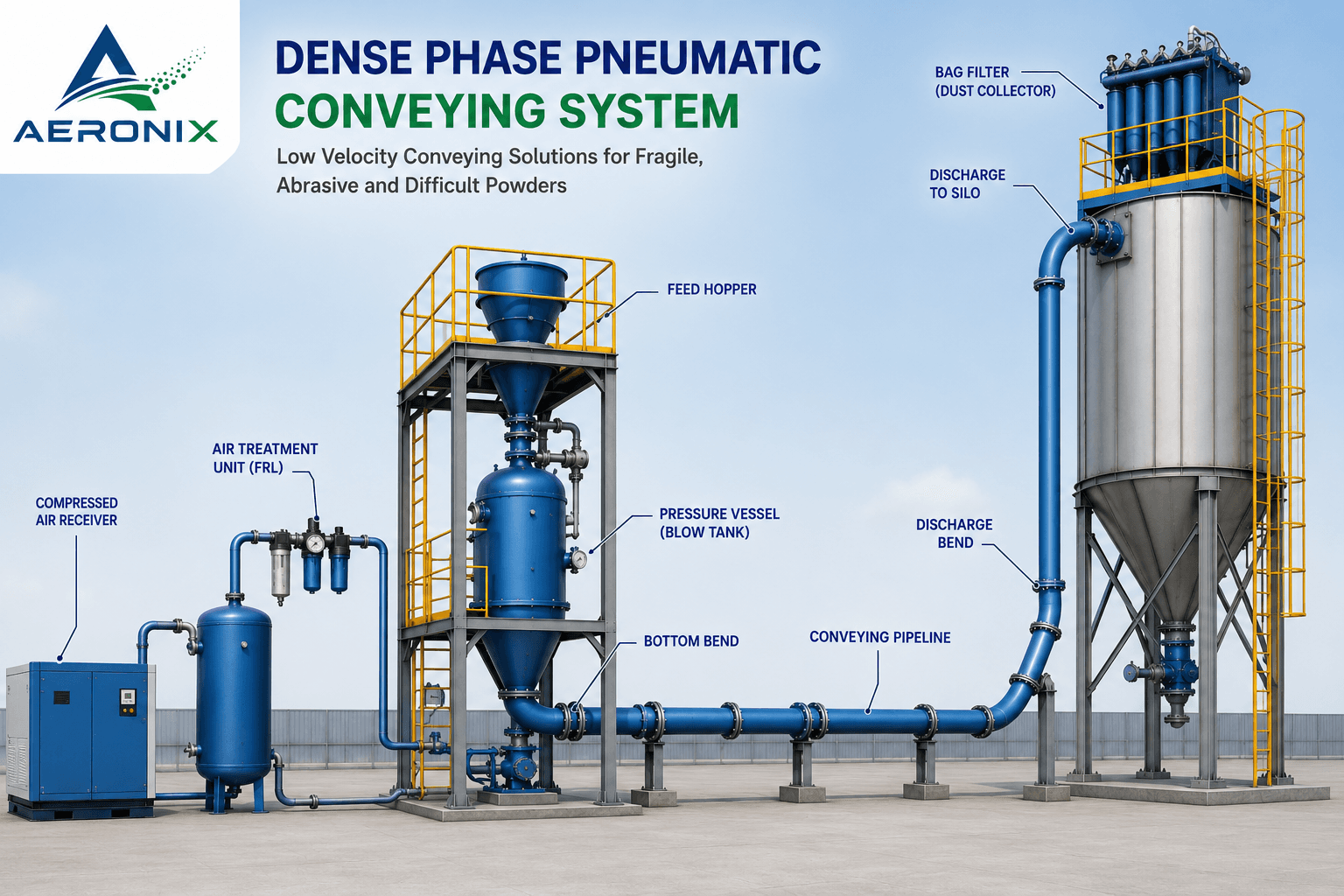
Dense Phase Pneumatic Conveying System
Low Velocity Conveying Solutions for Fragile, Abrasive and Difficult Powders
Engineered For Performance. Designed For Reliability.
AERONIX Systems LLP specializes in the design, engineering, manufacturing, installation, and commissioning of Dense Phase Pneumatic Conveying Systems for efficient handling of powders, granules, pellets, and bulk solids.
Our engineering team brings more than 17 years of practical experience in designing dense phase conveying systems for food, dairy, pharmaceutical, chemical, plastic, mineral, pigment, recycling, and specialty material applications.
Dense phase conveying is one of the most efficient and reliable methods for transporting difficult materials while minimizing product degradation, pipeline wear, dust generation, and energy consumption.
What is Dense Phase Conveying?
Dense phase conveying is a pneumatic conveying method where bulk materials are transported through pipelines at relatively low conveying velocities and higher operating pressures.
Unlike lean phase conveying, where particles remain suspended in the air stream, dense phase conveying transports material in compact plugs, dunes, or slug formations.
Because material velocity remains low, particle breakage, attrition, segregation, and pipeline erosion are significantly reduced.
This makes dense phase technology ideal for fragile, abrasive, friable, and difficult-to-handle materials.
How Dense Phase Conveying Works
The conveying cycle typically follows these steps:
Step 1 – Material Loading
Material enters a pressure vessel or blow tank.
Step 2 – Vessel Pressurization
Compressed air is introduced into the vessel.
Step 3 – Material Discharge
Material is pushed into the conveying pipeline.
Step 4 – Plug Formation
Material moves through the pipeline in dense plugs or dunes.
Step 5 – Product Separation
At the destination, the material is separated from conveying air using:
- Cyclone Separator
- Dust Collector
- Bag Filter
- Product Receiver
Step 6 – Cycle Repetition
The system automatically repeats the sequence.
Benefits of Dense Phase Conveying
Minimal Product Degradation
Low conveying velocities reduce particle damage.
Suitable for:
- Rice
- Malt
- Plastic Pellets
- Food Ingredients
- Masterbatch
- Specialty Chemicals
Reduced Pipeline Wear
Lower material velocity dramatically reduces erosion.
Suitable for abrasive products such as:
- Fly Ash
- Silica
- Talc
- Calcium Carbonate
- Titanium Dioxide
Lower Maintenance Costs
Reduced wear leads to:
- Longer pipeline life
- Lower replacement costs
- Reduced shutdowns
- Increased system availability
Energy Efficient Operation
Dense phase systems often operate with lower air volumes compared to conventional lean phase systems.
This can significantly reduce operating costs.
Dust-Free Material Transfer
Fully enclosed conveying ensures:
- Clean operation
- Environmental compliance
- Reduced product loss
- Improved housekeeping
Longer Conveying Distances
Dense phase systems are suitable for:
- Short distances
- Medium distances
- Long-distance conveying applications
depending on material characteristics and system design.
Types of Dense Phase Conveying Systems
Blow Tank Conveying System
The most common dense phase technology.
Material is loaded into a pressure vessel and discharged using compressed air.
Applications:
- Fly Ash
- Carbon Black
- Calcium Carbonate
- Cement
- Pigments
Pulse Dense Phase Conveying
Material is transported using controlled pulses of compressed air.
Advantages:
- Extremely low velocity
- Gentle handling
- Lower air consumption
Continuous Dense Phase Conveying
Designed for processes requiring uninterrupted material flow.
Applications:
- Continuous production lines
- Process plants
- High-capacity operations
Major Components
Blow Tank
Pressure vessel used for material loading and discharge.
Air Compressor System
Provides compressed air required for conveying.
Pipeline Network
Designed according to:
- Capacity
- Distance
- Material characteristics
- Wear considerations
Air Control Valves
Used for:
- Pressurization
- Fluidization
- Material discharge
- Sequence control
Dust Collection Equipment
Includes:
- Bag Filters
- Cartridge Filters
- Cyclone Separators
Control System
PLC-based automation controls the complete conveying sequence.
Materials Suitable for Dense Phase Conveying
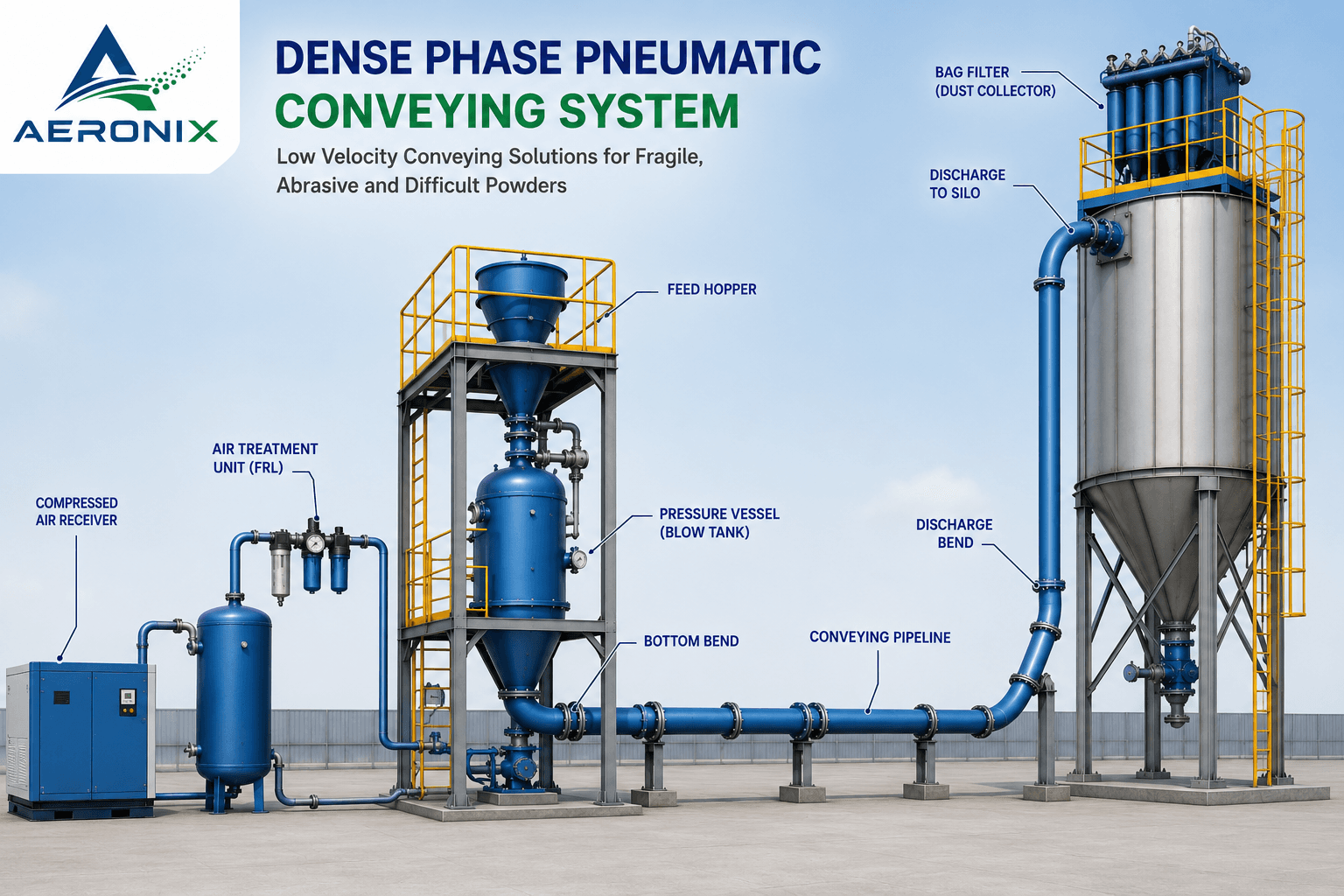
Engineered for Reliability
Food & Dairy Products
- Malt
- Rice
- Milk Powder
- Whey Powder
- Sugar
- Starch
Chemical Products
- Titanium Dioxide
- Pigments
- Additives
- Resins
- Specialty Chemicals
Plastic Industry Materials
- PVC Resin
- CPVC Compounds
- Polymer Pellets
- Masterbatch
- PET Chips
Mineral Products
- Talc
- Silica
- Calcium Carbonate
- Bentonite
- Fly Ash
Carbon Black Applications
Dense phase conveying is widely used for carbon black because it minimizes:
- Product degradation
- Dust generation
- Material loss
- Filter loading
Industries Served
Food Processing Industry
Dairy Industry
Pharmaceutical Industry
Chemical Industry
Petrochemical Industry
Plastic & Polymer Industry
Paint & Pigment Industry
Recycling Industry
Mineral Processing Industry
Battery Material Industry
Dense Phase vs Lean Phase Conveying
Parameter
Dense Phase
Lean Phase
Velocity
Low
High
Pressure
High
Low
Product Degradation
Minimal
Higher
Pipeline Wear
Low
Higher
Air Consumption
Lower
Higher
Capital Cost
Higher
Lower
Maintenance Cost
Lower
Higher
Suitable for Abrasive Materials
Excellent
Moderate
Design Considerations
Every dense phase conveying system must be designed based on:
Material Bulk Density
Particle Size Distribution
Moisture Content
Abrasiveness
Fragility
Conveying Capacity
Conveying Distance
Available Utilities
Plant Layout
Future Expansion Requirements
Improper design can result in:
- Pipeline blockage
- Product degradation
- Excessive air consumption
- Poor system performance
Therefore, engineering evaluation is critical before system selection.
Why Choose AERONIX?
17+ Years of Practical Experience
Application-Based Engineering
Customized System Design
Cost-Effective Solutions
Turnkey Project Responsibility
Reliable Equipment Selection
Installation & Commissioning Support
Responsive Technical Service
Frequently Asked Questions
Is dense phase conveying suitable for fragile materials?
Yes. Dense phase conveying minimizes particle breakage due to low conveying velocity.
Is dense phase conveying suitable for abrasive materials?
Yes. It significantly reduces pipeline wear compared to lean phase conveying.
What conveying distances are possible?
Distances depend on material characteristics and system design. Both short and long-distance applications can be achieved.
Can existing lean phase systems be upgraded?
In many cases, existing systems can be modified or upgraded after engineering evaluation.
Which materials are best suited for dense phase conveying?
Carbon black, fly ash, talc, calcium carbonate, pigments, polymers, food ingredients, and many specialty powders.
Discuss Your Application
Whether you need a dense phase conveying system for carbon black, fly ash, calcium carbonate, pigments, polymers, food ingredients, or specialty powders, AERONIX Systems LLP can provide a customized and technically optimized solution tailored to your process requirements.
Contact our engineering team to discuss your material, capacity, conveying distance, and application requirements.
Need Technical Assistance?
Our engineering team is ready to analyze your material and recommend the perfect handling solution.
Request a QuoteRelated Solutions
Engineered for Performance.